What does it mean to return home? As time goes on, so much of the nostalgia we carry for the past steps out of sync with reality – places change, culture adapts, and the ancestral roots you remember slowly fade away. Last month, I traveled to Hong Kong for an artist residency at Eaton Hotel, with the goal of scouting locations – specifically a two-bedroom apartment – for my feature film, Bangbang Teahouse. I arrived thinking I would capture the essence of Hong Kong, to understand and personify the city as a character… But as I discovered, nothing is ever really that simple. I found myself humbled by this, unable to so easily define the city where my father grew up, where generations of my family have stemmed from, and where I, as a Chinese-American filmmaker, feel somewhat indebted to.
While most of my film is set in New York, it bookends with a prologue and epilogue set in Hong Kong that serve as a nod to my father’s past. A part of me hoped placing a scene there might draw me closer to him, and to the family and history I’ve always felt just slightly out of reach. Maybe, I hoped, filming in Hong Kong would make me feel more whole – a permanent stamp etched in celluloid saying: this is where I come from. My heart was set on shooting on location, despite some concerns from my U.S.-based producers (traveling halfway around the world for two days of shooting is not the most cost-efficient use of money, especially for an indie film like ours). I needed to find an apartment that was “iconically Hong Kong,” one that was irreplicable in the United States; otherwise, why make the trip?
On the first day of scouting, my producers and I visited two abandoned Tong Lau buildings. They were somewhat rundown, most definitely requiring a fair amount of work to create a “lived-in” feel needed for our scenes… Even so, they had all the design elements I sought. I fell in love with the architecture, marveling at the beautifully arched doorways, and immediately envisioned depth to our framing, staging various characters in different spaces simultaneously, creating a rich, cinematic tableau. My eyes widened, enchanted by the intricate iron grilles on the windows, the honeycomb-shaped breeze blocks, the floral-patterned wallpaper, even the unique window hinges. I was delighted; nowhere in the States could we find something as organic and striking as these Tong Lau buildings. The outlines of Hong Kong’s character were starting to take shape…
…But the train ride back to Eaton made me rethink my approach. I struck up a conversation with our location manager, seeing if I could gain insight from someone who’s lived her whole life in Hong Kong. What began as a casual conversation wound up affecting me more than expected. I asked if she saw herself living in Hong Kong long-term, and to my surprise, she replied “no.” A resigned melancholia settled in. She spoke about how much the city has changed, how quickly people have abandoned their culture in the pursuit of profit. The culture of her youth has largely vanished – even grocery store snacks now cater to Mainland tastes. While she will always love Hong Kong, she said recent changes have put her future there in doubt. She found it all disheartening, exhausted from holding onto the past. Sensing her weariness, I decided not to pry further.
Restless, jet-lagged, my mind began to wander in my hotel room. Was I chasing something that was gone? I couldn't help but feel this journey was partly in vain. I reflected on my desire to preserve my dad’s life in Hong Kong, and my somewhat irrational belief that filming here would create a deeper connection to him. It reminded me of my film’s protagonists, Mimi and Hayley, who also grapple with their need to hold onto the past. They struggle to let go, wanting to preserve their family’s history through their music, believing that doing so will give their lives meaning… Perhaps that’s what I’m doing with my film. Maybe instead of trying to find Hong Kong’s true essence and spirit, what I was really trying to do was find myself here, in the past of an old tenement building, brought back through the magic of cinema. I fell asleep swimming in thought, lost in a city I thought I was beginning to understand…
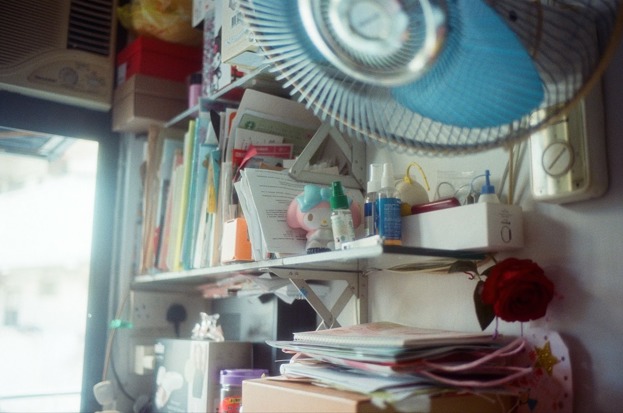
The next day, we visited real homes, occupied by people. There was more life, more vibrancy, even if the buildings were more modern in design than the architecturally-striking Tong Laus. Cluttered with memorabilia spanning decades, serving as time capsules. A Marilyn Monroe poster hung beside a painting of an emo fairy, next to intimate family photos. It all blurred together – there was no sense of time or history here, unlike the Tong Laus, sitting abandoned in decay. The homeowners were incredibly generous and welcoming, thrilled to share the stories behind the trinkets that lined their shelves. I pulled out my camera and found myself focusing on the mementos, rather than aesthetics or architecture, deeply moved and inspired by the authentic flashes of life found in these personal belongings – a soul that couldn’t be replicated anywhere else. The micro instead of the macro. As much as filmmaking is about design and composition, it also must have warmth. Humanity.
It’s no secret Hong Kong is in flux; caught between the past and future, trying to maintain its identity amidst so much change. I can relate in more ways than one; it’s a theme that has long been central to my work. On my flight back to New York, it dawned on me that maybe I’ve been trying too hard to grasp onto the parts of myself that I fear are fading away: my dad’s story, the home he grew up in, the fabric of my family tree. As much as I want to hold tight, maybe the best way to honor them is to look ahead, trusting that they will always remain within me. That faith must guide me in my filmmaking, especially when it’s time to shoot this story.
I came to Hong Kong hoping to define it, but I was left with more questions than answers about the nature of belonging. And instead of trying to name the essence of Hong Kong, perhaps it’s more meaningful to simply observe and capture what’s in front of me, without forcing a narrative. To trust my instinct, my voice. And as I look ahead to 2026, I hope to travel to Hong Kong more often as a tourist, not as a filmmaker, to really experience Hong Kong without an agenda or assignment. Appreciate the nuances, absorb the city with wanderlust and curiosity. And in turn, it will inform my work.
It turns out you can go home again… But neither you, nor the place you return to, will ever be the same.
Courtney Loo
Published:
10 Feb 2026
Tags: